The New Standard for EdTech: Why Evidence-Based, Hands-On STEM Learning Matters More Than Ever
For years, education technology has been sold with familiar promises: more engagement, more innovation, more technology in the classroom, and more recently, more AI.
But schools are increasingly asking a much more important question: Does the technology actually help students learn?
That shift matters. The U.S. Department of Education is putting greater emphasis on evidence, transparency, educator judgment, thoughtful implementation, and ongoing evaluation when schools adopt education technology.
For EdTech companies, that creates a higher bar. Technology should not earn a place in the classroom simply because it is new or exciting. It should earn that place because it solves a clear instructional problem and produces meaningful learning experiences.
At Space Kitz, we think that is exactly the direction STEM education should be moving.
Signal Hunters was not designed to give students another screen to look at. It was designed to give students something real to build, capture, analyze, investigate, and explain.
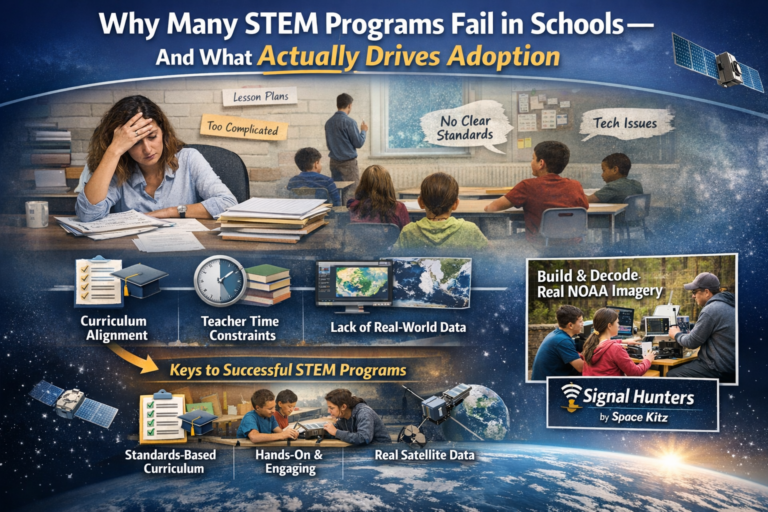
Students build a working satellite ground station, receive transmissions directly from satellites in orbit, decode real satellite imagery, and use that data to explore weather, Earth science, physics, communications, and space technology.
Viewed through this new evidence-first approach to EdTech, there are five questions every education technology company should be prepared to answer.
1. What Learning Problem Does Your EdTech Product Solve?
This should be the first question asked about any classroom technology.
Not: Does it use artificial intelligence? Does it have impressive features? Will students think it is cool?
The real question is: What instructional problem are we trying to solve?
One challenge in STEM education is the gap between learning scientific concepts and experiencing how those concepts operate in the real world. Students may learn about electromagnetic waves, satellite orbits, weather systems, climate, radio communications, data transmission, remote sensing, and Earth observation, but much of that learning still happens through textbooks, worksheets, videos, websites, and simulations.
Students may look at a satellite image or watch a video explaining how satellites communicate, but they rarely get the opportunity to participate in the process themselves.
Signal Hunters Turns Abstract STEM Concepts Into Real Experiences
With Signal Hunters, students construct a real satellite receiving station using antennas, radio components, software-defined radio technology, Raspberry Pi hardware, and communications equipment.
Then they point that system toward space.
Instead of simply downloading a sample satellite image from a website, students can receive and decode imagery transmitted directly from orbit. They move from consuming scientific information to collecting scientific information.
They are not just learning about satellite communication. They are using it. They are not simply looking at Earth observation data. They are receiving it.
Signal Hunters supports that experience with curriculum covering satellites, orbital science, radio communications, encoding, weather, Earth science, and satellite data analysis.
That is the instructional problem Signal Hunters is designed to address: How do we make complex STEM concepts tangible enough for students to investigate them themselves?
2. When Should Education Technology Be Used?
Another important shift in EdTech is recognizing that technology should not automatically be present in every lesson.
The goal should never be more technology. The goal should be better learning.
Signal Hunters is not intended to replace teachers, textbooks, classroom discussions, laboratories, or traditional science instruction. It gives educators another tool to use when direct interaction with real-world technology and data improves the lesson.
Where Signal Hunters Fits Into STEM Curriculum
Signal Hunters can support instruction in areas including:
- Earth and space science
- Meteorology
- Weather and climate
- Physics
- Electromagnetic spectrum
- Satellite communications
- Radio frequency technology
- Software-defined radio
- Coding and computing
- Binary and hexadecimal systems
- Engineering design
- Remote sensing
- Data science
- Environmental science
- Career and technical education
- Aerospace and space systems
For example, a teacher discussing geostationary orbit can explain why a satellite appears fixed over one region of Earth. With Signal Hunters, students can go further by building the ground station that receives transmissions from those satellites.
A teacher can explain infrared satellite imagery. Students can then capture satellite data and investigate what the imagery reveals about clouds, temperature, and weather systems.
A class can study severe weather in a textbook, or students can examine current Earth observation data while an actual weather system is developing.
That creates something education technology should be especially good at: connecting curriculum to the real world.
3. Who Should Use EdTech Like Signal Hunters?
No education technology tool is appropriate for every learner, grade level, subject, or situation.
Signal Hunters is primarily designed for middle school and high school STEM education, although activities can be adapted based on the complexity of the lesson and level of teacher support.
It can be particularly valuable for:
- Middle school STEM programs
- High school science classrooms
- Earth and space science courses
- Physics programs
- Engineering classrooms
- STEM labs
- Aerospace programs
- CTE programs
- Climate and environmental science programs
- Robotics and technology programs
- After-school STEM programs
- Science clubs and space clubs
- Gifted and advanced learning programs
- Career exploration programs
Connecting Students to Real STEM Careers
Satellite technology sits at the intersection of many career pathways. Students encounter aerospace engineering, electronics, orbital mechanics, computer science, software, meteorology, telecommunications, data science, environmental science, and remote sensing.
That interdisciplinary nature matters because real scientific careers rarely exist inside a single subject-area silo.
A satellite system combines physics, engineering, software, mathematics, communications, Earth science, and data analysis. Signal Hunters allows students to see how those disciplines connect in an authentic application.
4. How Long Should Students Use Education Technology?
More time using technology does not automatically mean more learning.
One of the most useful questions educators can ask is: How much technology is actually necessary to accomplish the learning objective?
Signal Hunters is designed around a clear progression rather than maximizing device time.
Build
Students assemble and configure a functioning satellite ground station.
Capture
Students receive real signals transmitted from satellites in orbit.
Decode
Students transform those signals into usable information and imagery.
Analyze
Students investigate weather and Earth observation data.
Explain
Students connect their observations back to scientific concepts and communicate what they discovered.
The technology is only one part of the learning experience. Students still have to ask questions, make observations, troubleshoot, calculate, discuss, research, analyze data, compare results, form explanations, and present findings.
In other words, Signal Hunters is not designed to maximize screen time. It is designed to maximize scientific participation.
5. What Evidence Shows That the EdTech Improves Student Learning?
This may be the most important question of all, and EdTech companies need to become comfortable answering it.
For years, education technology vendors have often treated engagement as a proxy for learning.
Students loved it. Teachers thought it was exciting. Usage increased. Students spent more time in the application.
Those can all be useful signals, but they are not the same thing as evidence that students learned more.
STEM companies need to move beyond simply asking, “Did students enjoy it?”
We should also ask what students understand and what they can do after the experience.
What Can Students Explain?
After using Signal Hunters, can students explain:
- Why geostationary satellites remain over the same region?
- How antennas receive electromagnetic signals?
- How information travels from a satellite to a ground station?
- How visible and infrared satellite imagery differ?
- How satellite observations relate to weather patterns?
- Why scientists observe Earth using different wavelengths?
What Can Students Do?
Can students:
- Assemble a functional receiving system?
- Align and configure an antenna?
- Troubleshoot signal reception?
- Capture satellite data?
- Decode digital information?
- Analyze satellite imagery?
- Communicate conclusions based on real observations?
Those are measurable outcomes.
Engagement Matters, but Engagement Is Not the Finish Line
None of this means student engagement is unimportant.
Engagement can be incredibly valuable. A student who suddenly becomes curious about satellites, meteorology, engineering, coding, or radio communications may begin asking questions they never would have asked during a traditional lesson.
But engagement should lead somewhere.
Curiosity should lead to investigation. Investigation should lead to understanding. Understanding should lead to students demonstrating what they have learned.
That is the standard EdTech should be working toward.
Seeing an image of Earth appear on a classroom computer after students have received the signal themselves can create a powerful moment. But the bigger opportunity comes afterward.
What questions do students ask? What patterns do they notice? What scientific concepts can they now explain? What new skills can they demonstrate?
That is where excitement becomes education.
Real Satellite Data Changes the STEM Classroom
One of the most powerful characteristics of Signal Hunters is that the data is not manufactured for a classroom exercise.
It comes from space.
Students can receive satellite imagery associated with real atmospheric and environmental conditions rather than relying entirely on static classroom datasets.
That creates a very different learning environment.
The teacher does not necessarily know exactly what today’s satellite image will reveal. Students may capture a developing storm, cold front, cloud system, hurricane activity, temperature differences, or changing atmospheric patterns.
Tomorrow’s data may look completely different.
The Lesson Becomes an Investigation
That is much closer to how actual science works.
Scientists do not always begin with a worksheet containing a predetermined answer. They collect data, observe, question, compare, interpret, and revise their thinking.
Authentic satellite data gives students an opportunity to practice that same process.
Instead of asking, “What answer is the teacher looking for?” students can begin asking, “What does the data actually show?”
Hands-On STEM Should Mean More Than Assembly
Many STEM products describe themselves as hands-on because students assemble something.
Building is valuable, but hands-on STEM should go further.
With Signal Hunters, building the satellite ground station is only the beginning. Students then use what they built to interact with an actual communications system operating far beyond their classroom.
The hardware becomes an instrument for scientific discovery.
That distinction is important because it moves students beyond following instructions.
They build something with a purpose, operate it, collect information from it, troubleshoot it, and use the results to investigate scientific questions.
That is the difference between a STEM activity and a STEM learning platform.
What Evidence-Based EdTech Can Look Like in Practice
The next generation of STEM programs should make evaluation easier for schools, not avoid it.
Schools using Signal Hunters can evaluate outcomes through several different forms of evidence.
Knowledge Assessments
Educators can measure student understanding before and after instruction in areas such as:
- Satellite orbits
- Electromagnetic waves
- Weather satellites
- Remote sensing
- Digital communication
- Earth observation
Performance-Based Assessments
Students can demonstrate whether they are able to assemble hardware, configure systems, receive signals, decode data, interpret imagery, and troubleshoot problems.
Student Research Projects
Students can use satellite data to investigate authentic scientific questions and compare observations over time.
Scientific Communication
Students can present their observations, methods, analysis, and conclusions to classmates, teachers, or the broader school community.
Teacher Observations
Educators can document changes in student understanding, questioning, persistence, collaboration, and technical ability.
Student Reflections
Students can explain what they learned, what challenged them, how they solved problems, and how their understanding changed.
Taken together, these approaches provide a much richer picture of learning than simply tracking how long a student used a piece of technology.
EdTech Should Make Teachers More Powerful, Not Less Important
Responsible education technology should strengthen educator judgment rather than attempt to replace it.
The best classroom technology gives teachers new opportunities to create experiences that would otherwise be difficult or impossible.
A science teacher may not have previously taught satellite communications. A STEM teacher may never have configured a software-defined radio. An Earth science teacher may understand satellite imagery but never have built a ground station.
That is why effective implementation needs more than hardware.
Signal Hunters combines the physical technology with structured curriculum and learning resources so teachers can connect the experience directly to classroom instruction.
The technology provides access.
The curriculum provides structure.
The teacher provides context, questioning, instruction, and meaning.
The Future of EdTech Is Not More Technology
Schools do not need technology simply because technology exists.
They do not need another dashboard, another login, or another device whose primary selling point is that students think it is exciting.
They need learning experiences worth protecting classroom time for.
The higher bar being placed on education technology is a good thing.
Every EdTech company should be prepared to explain:
- What learning problem are we solving?
- When should this technology be used?
- Which students and learning environments is it designed for?
- How much use is appropriate?
- How will we know whether students actually learned something?
If a program cannot answer those questions, schools should ask why.
Why Signal Hunters Fits the Direction STEM Education Is Heading
Signal Hunters was built around a simple idea:
Space science becomes more meaningful when students can actually participate in it.
Students build a satellite ground station. They receive real signals. They decode data. They analyze satellite imagery. They investigate real-world conditions. They explain what they discover.
The satellite is real. The signal is real. The data is real.
And the questions students can investigate are real.
That does not eliminate the responsibility to demonstrate learning impact. It makes that responsibility even more important.
Because the goal of Signal Hunters is not simply to make students say:
“That was cool.”
The goal is for students to walk away saying:
“I understand how that works because I actually did it.”
That is the kind of standard education technology should be held to, and it is the kind of classroom experience we believe the future of STEM education needs.
Bring Real Satellite Data Into Your STEM Classroom
Signal Hunters by Space Kitz gives middle and high school students the opportunity to build a satellite ground station and receive real satellite data directly from space.
The program brings together hands-on STEM learning, satellite communications, Earth science, weather, physics, engineering, data analysis, and space technology in one authentic learning experience.
For schools, districts, STEM labs, CTE programs, and science departments looking for an education technology program built around active investigation rather than passive technology consumption, Signal Hunters offers students a chance to do something most classrooms never get to experience.
Don’t just teach students about space. Let them connect to it.